
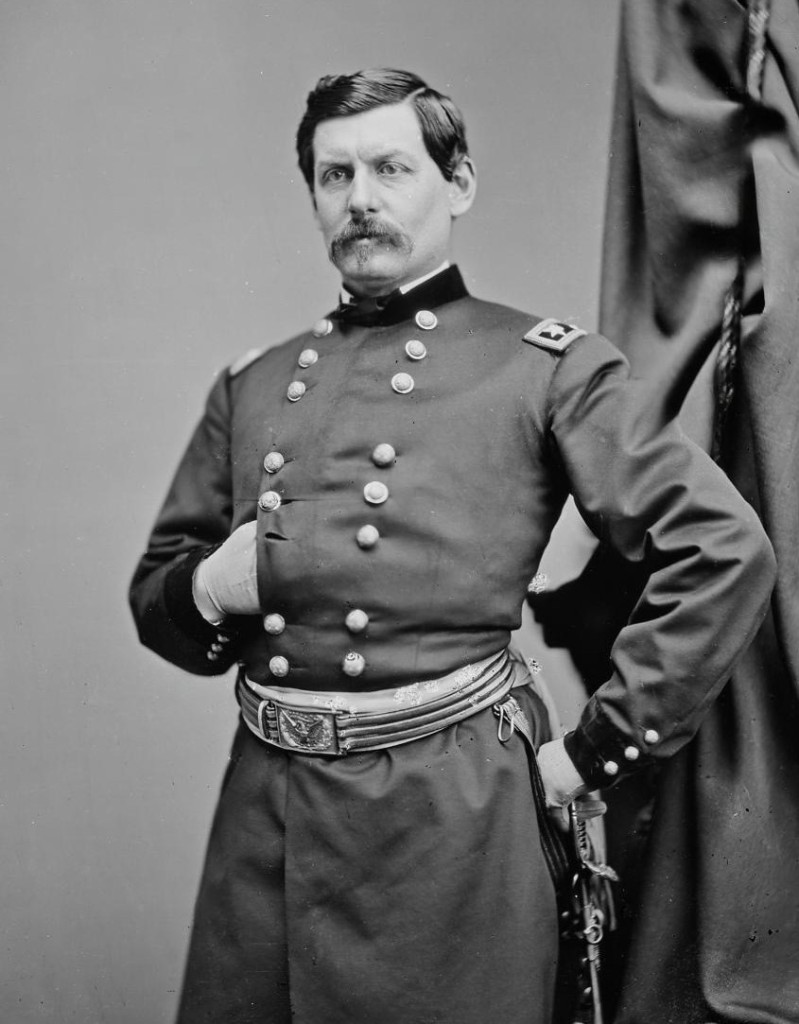
In my next three blog posts I will highlight a Civil War Union General who Abraham Lincoln put his trust in to lead the Union army. I will focus on George B. McClellan, Ulysses S. Grant, and William T. Sherman. For each general, I will use six words to describe them as a general. I will then elaborate on the word chosen. To close, I will explain the general’s impact on the Civil War.
George B. McClellan
a. Administrator– McClellan was known for being a good administrator and his soldiers admired him. At the start of the war, he played an important role in raising an organized and well-trained army, which would become known as the Army of the Potomac.
b. Cautious– McClellan always believed that the Confederate army was larger than it was. He often believed that he needed more men and frequently asked for reinforcements, and therefore, he was overly cautious. At the start of the war he complained that he needed 270,000 soldiers when he had 120,000. McClellan worried too much about what the enemy might do. At Antietam, his subordinates urged him to send in reserve troops, but McClellan would only do so if it was absolutely necessary. McClellan missed opportunities to give a decisive blow to the enemy.
c. Hesitant– McClellan often believed that he was not given the proper resources to conduct a campaign. He complained of not enough men and not enough supplies. Because of this hesitance, his first campaign, the Peninsula Campaign, did not begin until March 1862, nearly a year after hostilities had begun. The newspapers, as well as Lincoln became very impatient with McClellan. Lincoln is quoted as saying that he would like to “borrow McClellan’s army if the general himself was not going to use it.”
d. Selfish– McClellan spoke negatively about Lincoln and other politicians in the Congress and the Cabinet, and even looked down on the President as someone with no military experience. He thought they were ignorant to the real needs of battle, while he, on the front lines, did not have the resources to attack. While everyone was pushing for McClellan to attack the Confederate army, McClellan didn’t listen. He seemed to care more about his own personal success than the success of the army, and he feared losing. After his failure to attack Lee’s retreating army at Antietam, McClellan believed that his actions during the battle were a “masterpiece of art.”
e. Paranoid– McClellan often believed that Lincoln and other politicians who were frustrated with him were talking behind his back, and trying to get him removed from his command. In a letter, he even called Lincoln, “nothing more than a well-meaning baboon…” His paranoia on the battlefield left him at a mental disadvantage. McClellan’s fear of failure hindered his ability to succeed militarily.
f. Indecisive– During the Seven Days’ Battles (June- July 1862), Robert E. Lee took over Confederate command and was much more aggressive than the previous Confederate General, Joseph E. Johnston. Lee so unnerved McClellan that he retreated back down the peninsula to the sea. McClellan again showed his indecisiveness at the Battle of Antietam. Although this was a Union victory, McClellan never ordered an attack during Lee’s retreat even though he greatly outnumbered Lee’s army. This infuriated Lincoln, and McClellan was fired in November, 1862.
George B. McClellan was a hindrance to Lincoln and the Union war effort. At the start of the war, Lincoln chose “The Young Napoleon” because McClellan had proven himself at West Point and the Mexican-American War to be an outstanding field commander. However, McClellan’s cautiousness led Lincoln and McClellan to be constantly at odds with one another, and they grew to distrust each other. This only created more stress for the Commander-In-Chief and the Northern newspapers. There were even rumors that McClellan was working for the Confederacy. While McClellan was at the head of the army, the Union Army of the Potomac faced set-back after set-back. The war in the Eastern Theater was going so poorly that Northerners were losing faith in the Union War effort. After Antietam, Lincoln removed McClellan from command and he would not lead a Union army again. He continued to be a hindrance to Lincoln by running as a Democrat in the 1864 Presidential Election. Although Lincoln was the victor, McClellan may have sought to make peace with Confederacy had he been elected President.
Stay tuned for Part 2 on Ulysses S. Grant.
Related Posts:
 Benevento's History Blog
2 responses to “Lincoln’s Generals in Six Words: George B. McClellan”
Could not disagree one word with you about McClellan.
LikeLike
I almost feel bad for McClellan. I wish my words didn’t have to be so harsh, but he really couldn’t get out of his own way.. and he could never find fault in himself.
LikeLike