
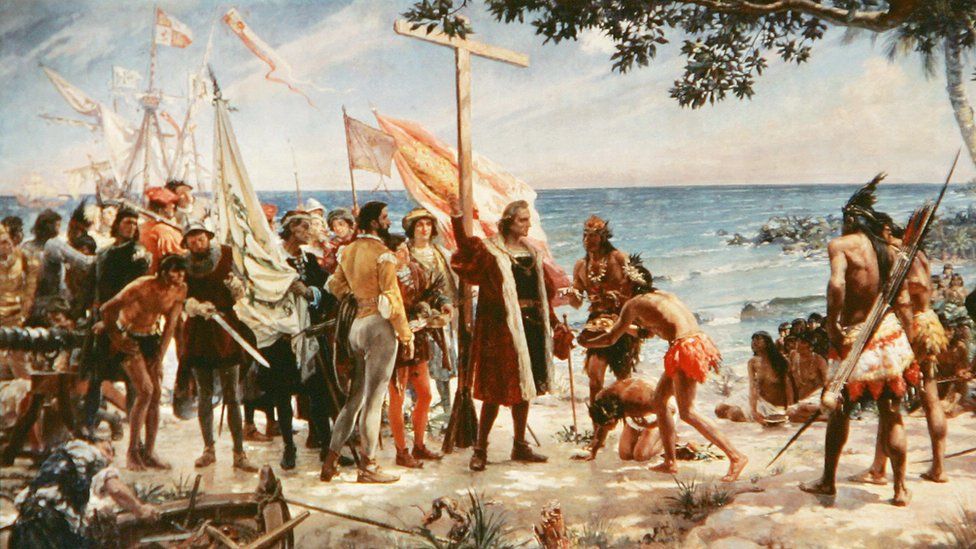
Today there is a wide range of views of Christopher Columbus as an individual. No matter what you think of him, there is no denying that his first voyage that landed in the Americas was one of the most significant events in human history. When other European explorers realized that Columbus had not landed in Asia, but in a “New World” a wave of Europeans came over to search for overnight wealth in gold, new opportunities in farming and mining, and to settle down and create a new life. This Age of Exploration was devastating to the Natives of the Americas who fell victim to the new diseases introduced by this new wave of settlers. The Natives had no immunity to the diseases and in some places up to 90% of the Natives died. In conflicts, the Europeans had superior weaponry and armor, which further devasted the Natives.
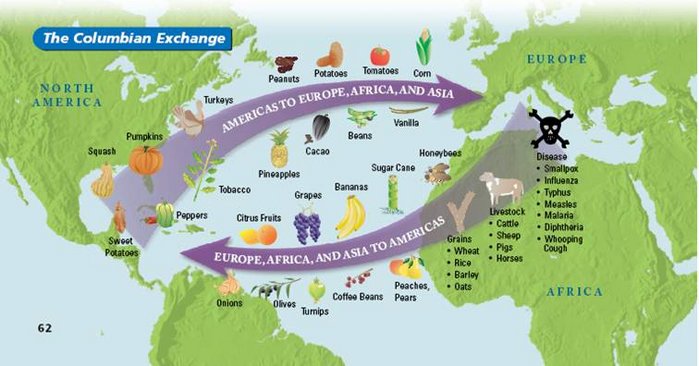
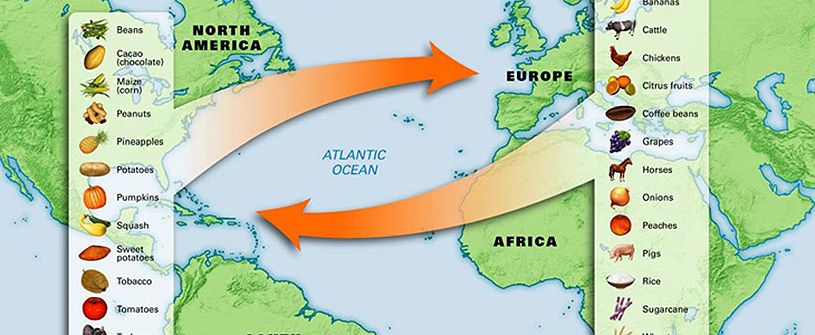
When Columbus and his men came over, they brought with them plants and animals that had never been introduced to the Americas before, but would later become staples in the Americas. The Europeans also brought back with them plants and animals, which then spread to Africa and Asia. Many of these plants and animals would later become staples of the “Old World” (Europe, Africa and Asia). The Columbian Exchange is defined as the exchange of plants, animals, diseases and ideas between the Old World and the New World that began in 1492. This global exchange had a widespread and long-lasting impact on all parts of the world.
From Europe to America: Animals
When Europeans came to the New World, they brought with them domesticated livestock. Some examples include chickens, cattle, goats, pigs, sheep, and horses. These animals were introduced to the Americas for the first time. The Native Americans had very few domesticated animals, one being the llama of South America. We often see images and paintings of Native Americans riding on horseback. This would not have been the case before 1492. The horse revolutionized Native American life by allowing tribes to hunt buffalo far more effectively. Other animals provided meat, tallow, hides, transportation and hauling.

From Europe to America: Crops
Europeans brought over new crops that had never grown in the Americas before. Most were brought over intentionally, some unintentionally. Crops brought over and introduced to the Americas for the first time included wheat, oats, barley, rye, rice, coffee, tea, sugar cane, dandelions, onions, bananas, apples, oranges, and other citrus fruits. All of these crops would have a huge impact on the development of the Americas. Sugar quickly became the mainstay of Caribbean and Brazilian economies. Rice, cotton, and tobacco formed the basis of many slave societies including in the future United States. We think of coffee as being a staple of South America. This was not the case before 1492.
From Europe to America: Disease
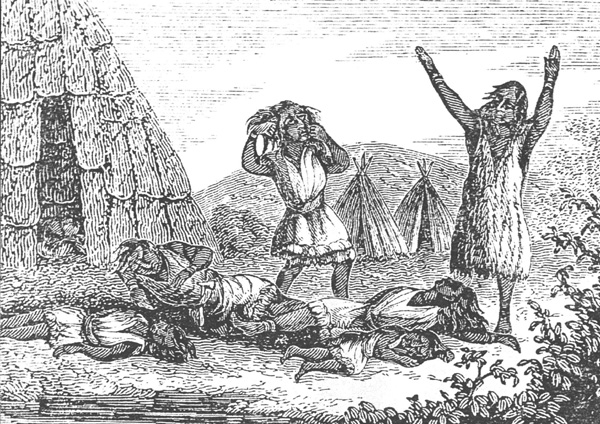
Diseases unintentionally brought over from Europe to the Americas had a dramatic impact on the Native American population. In some cases, diseases spread faster in-land than actual people. Why did diseases flow from Europeans to the Natives and not vice-versa? Because of the fact that Native Americans had few domesticated animals, the Natives also had fewer communicable diseases that spread. The Old World and the New World were meeting for the first time. Therefore the Native Americans had no immunity to Old World diseases. People from Europe, Africa and Asia had built up immunity to the many diseases that spread in the Old World.
Old World diseases that spread from the Europeans to the Natives included smallpox, measles, mumps, whooping cough, influenza, chicken pox, and typhus. Between 1492- 1650 its estimated that up to 90 percent of the Native Americans had died. The Native American population of Mexico went from about 25 million in 1518 to about 2 million in 1593. (Source: James et al., The Key to Understanding Global History, Jarrett Publishing) With entire villages dying from disease, new waves of European settlers found it much easier to take the land.
From America Back to Europe: Animals
The flow of animals in the Columbian Exchange had little impact on Europe because of the lack of domesticated animals already in the Americas. Two animals that did make it to the Old World was the turkey and the raccoon. Raccoons were fancied for their furs which led to a lucrative fur trade.
From America Back to Europe: Crops
Many crops which were indigenous to the Americas were brought back to Europe and then spread to Asia and Africa. Corn was brought back to Spain and quickly spread to other parts of the world. Other crops included squash, pumpkins, beans, sweet potatoes, tomatoes, chili peppers, peanuts, chocolate, potatoes and tobacco.
The tomato was brought to Italy in the Columbian Exchange. At first, the tomato was only used for decoration. It would be well over a century before the tomato became a staple in Italian cuisine.
The potato had an enormous impact on European society. The potato grew very well in different regions including in Ireland’s soil. Before Ireland’s potato famine, nearly half of the population relied exclusively on the potato for their diet, and the other half ate potatoes frequently (Brittanica).
New foods became staples for people in the Old World. Diets improved tremendously because of this new exposure to nutritious and calorie-dense foods that they had never been exposed to before. New growing regions opened up for these new crops.
From America Back to Europe: Disease
The flow of diseases from the Americas to Europe was not significant. As mentioned above Native Americans did not work closely with domesticated animals like Europeans had. Therefore, they had less communicable diseases that originate in animals. One disease that is believed to have spread from Native Americans to Europeans was syphilis which was then taken back and spread to Europe.
An Exchange of Ideas
Besides the physical items like plants and animals, ideas were spread between the Old World and the New World. The Native Americans taught the Europeans local farming methods. Europeans also adopted devices such as the canoe, the hammock and the poncho. The Native Americans were introduced to metalworking, new techniques of shipbuilding, and new forms of weaponry, including firearms.
Before the Columbian Exchange there were NO……
Oranges in Florida
Bananas in Ecuador
Tomatoes in Italy
Coffee in Columbia
Pineapples in Hawaii
Cattle in Texas
Chili Peppers in India
Cigarettes in France
Choclate in Swizerland
Potatoes in Ireland
How Has the Columbian Exchange Impacted Your Life?
We take for granted the many varieties of foods we are offered at the Supermarket. Think about what you eat on a daily basis. Where did those foods originate? Where did the ingredients originate? The Columbian Exchange set in motion a global network of trade that still has lasting impacts on our world today. Regions today are known for growing certain staples but in many instances, this would not have been the case before 1492.
Related Posts:
 Benevento's History Blog