
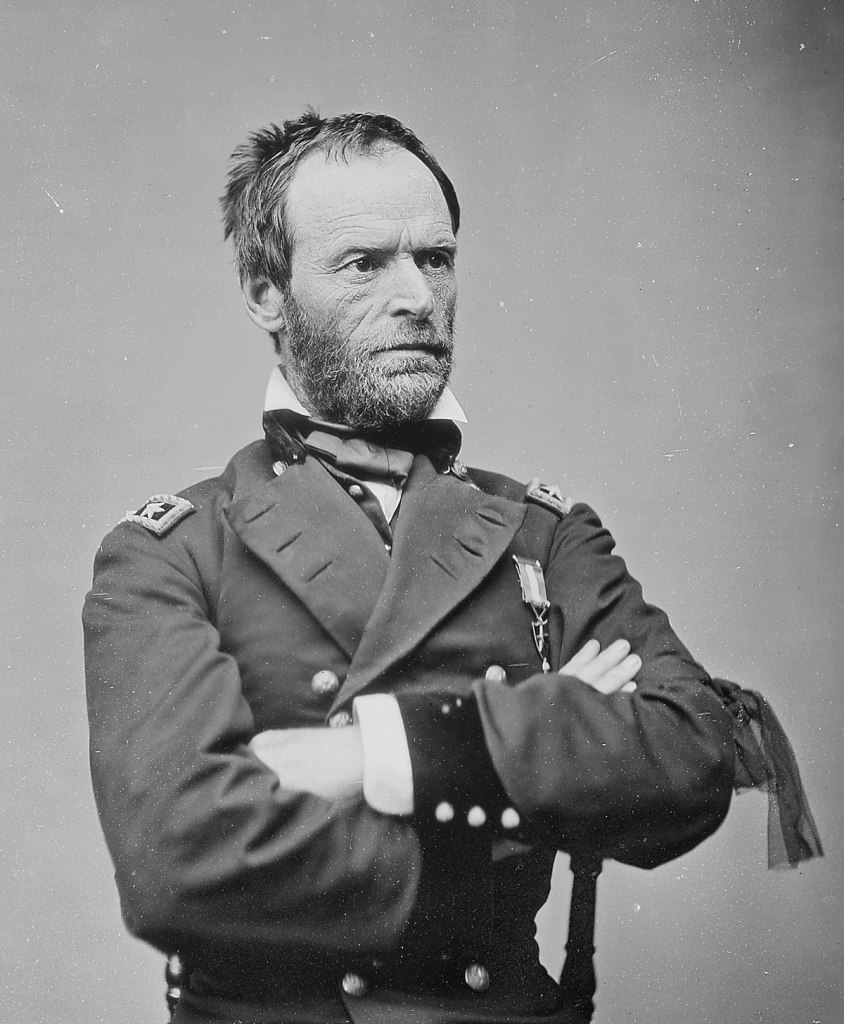
In my previous two blog posts, I highlighted Union Generals, George B. McClellan and Ulysses S. Grant. In this third and final post, I highlight Union General William T. Sherman as a Civil War general. I use six words to describe Sherman and provide an explanation for each. I also explain Sherman’s impact on the Civil War.
William Tecumseh Sherman
a. Aggressive– William Tecumseh Sherman knew that the only way to bring about the end of the Civil War, was to carry out a “total war”, bring the war to the citizens. This meant destroying cotton fields, livestock and infrastructure. He reasoned that the citizens kept the war going by producing weapons, growing food and transporting goods on which the armies relied. By bringing the war to the people, they would lose the will to fight. This was an aggressive stance by Sherman, but he believed that this would end hostilities.
b. Ruthless– Many believed that Sherman was ruthless, especially those in the South. His scorched-earth “March to the Sea” from Atlanta, Georgia to Savannah, and then up through the Carolinas, was seen by many as being too harsh on the South. He damaged many people’s homes and farms and left a wide path of destruction. He is quoted as saying, “We cannot change the hearts and minds of those people of the South, but we can make war so terrible… and make them so sick of war that generations would pass away before they would again appeal to it.”
c. Daring– By carrying out “Sherman’s March” he made a daring move. He would leave all supply lines, and his men would live off of the land. This was an extremely risky undertaking and could have gone horribly wrong. But as Sherman predicted, his march broke the back of the Confederacy. He showed that he was willing to take risks to complete his goals.
d. Unwavering– Sherman showed many times throughout the war that he was unwavering. He had a goal in mind and was steady in achieving it. In 1864, he had the objective of capturing Atlanta. Sherman had to settle in for a siege and made many attempts to seize railroad and supply lines leading to Atlanta. He stood the course and after a couple months, Atlanta finally fell in September 1864. Like his friend, Ulysses S. Grant, Sherman would not give up until victory was achieved.
f. Strategic– Sherman devised strategic plans to achieve his goals. As a commander, his plans ended in success. His strategy to take Atlanta as well as his “March to the Sea” ultimately achieved the goal of bringing the war closer to an end. When discussing his March to the Sea, many other commanders spoke against the plan. However, Sherman knew that his strategy would devastate the South and cause Southerners to turn against the war. History shows that Sherman was correct.
e. Charitable – Sherman’s military campaigns in the south and west freed tens of thousands of slaves who joined his march. Shortly before the end of the war, he promised the freed slaves who followed his army 40 acres of land per family and the use of army mules. Soon, about 40,000 freed persons settled on land in coastal Georgia and South Carolina. Later, however, the US government did not follow through on Sherman’s ideas of 40 acres and a mule.
William Tecumseh Sherman became one of Lincoln’s most trusted generals and he helped bring about the end of the Civil War. Sherman found success as a military commander in the west with Grant. He played an integral role in the Battles of Fort Henry, Fort Donelson, Vicksburg, and Chattanooga. When Grant was named the head of all Union armies, Sherman became the commander of the Western Theater. In the first half of 1864, Lincoln’s chance of winning re-election was questionable. The war was not going well, and his critics challenged his leadership. Northerners were losing faith in the war effort, and the Democrats’ platform called for a truce with the Confederacy. However, when Sherman captured the strategic transportation hub of Atlanta in September 1864, the tide turned. The North regained hope in the Union war effort and the people elected Lincoln as President to continue the war until victory was achieved. After Sherman’s March, he continued to head North in early 1865 to help Grant who was bogged down with Lee’s army in Virginia. The end was near, as the Confederacy surrendered in April 1865.
Related Posts:
 Benevento's History Blog