
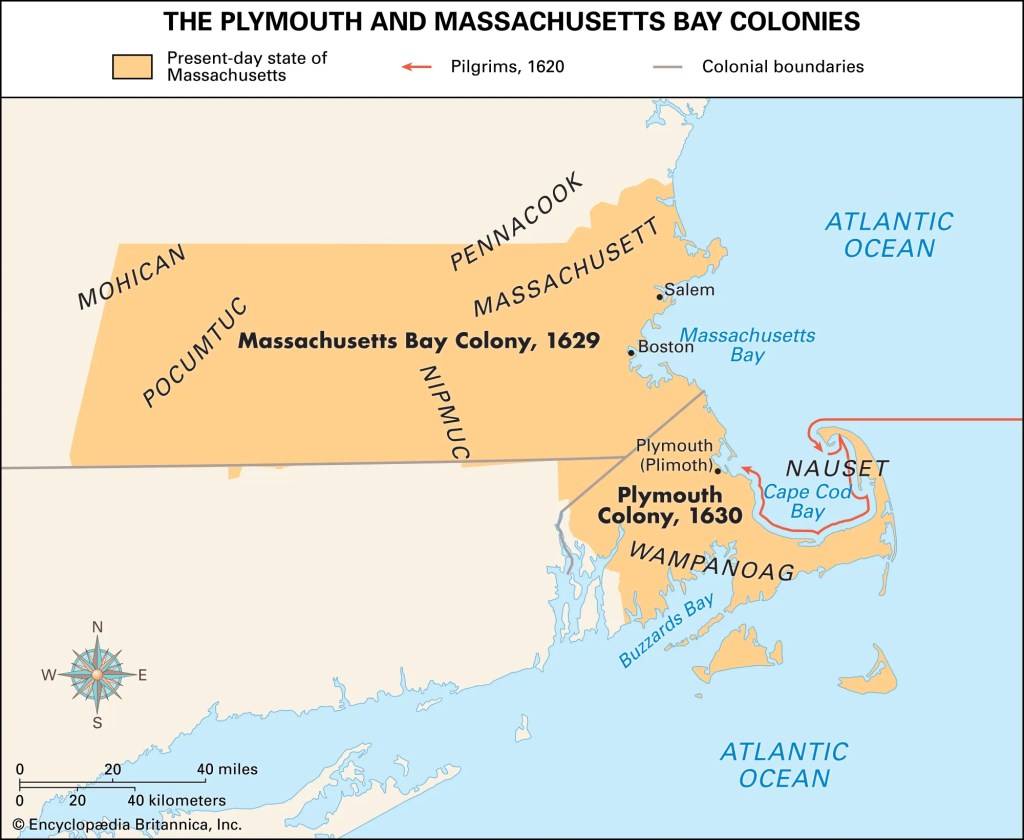
I am always intrigued to read and learn about the Puritans and the Massachusetts Bay Colony. I find the Puritans to be one of the most fascinating groups of people to study. On one hand, they disagreed with the strict practices and intolerance of the Church of England (The Anglican Church). And so they came to America for “religious freedom” but were very strict and intolerant towards other branches of Christianity themselves. Their religious fanaticism is evident in the events of the Salem Witch Trials. On the positive side, the Puritans’ ideas of representative government helped lay the foundations of the institutions that we still hold dear. From the Massachusetts Bay Colony, settlers branched out to settle the rest of New England. Like the Jamestown settlement of 1607, the Plymouth and larger Massachusetts settlements are truly remarkable stories. The odds of these first colonies surviving did not look promising at the start and the early settlers had to overcome extreme hardships. The early colonists found a way to survive and create the first permanent English settlements in North America. In my three-part blog post I address the following questions relating to the Massachusetts Bay Colony: Why did they settle there, what were the conditions like, and how did the colony become sustainable? I take a look at a typical day in the Massachusetts Bay Colony. I also discuss the significant historical events of the Salem Witch Trials and King Philip’s War. Finally, I discuss the long-term legacy of the Massachusetts Bay Colony.
Why did they settle there?
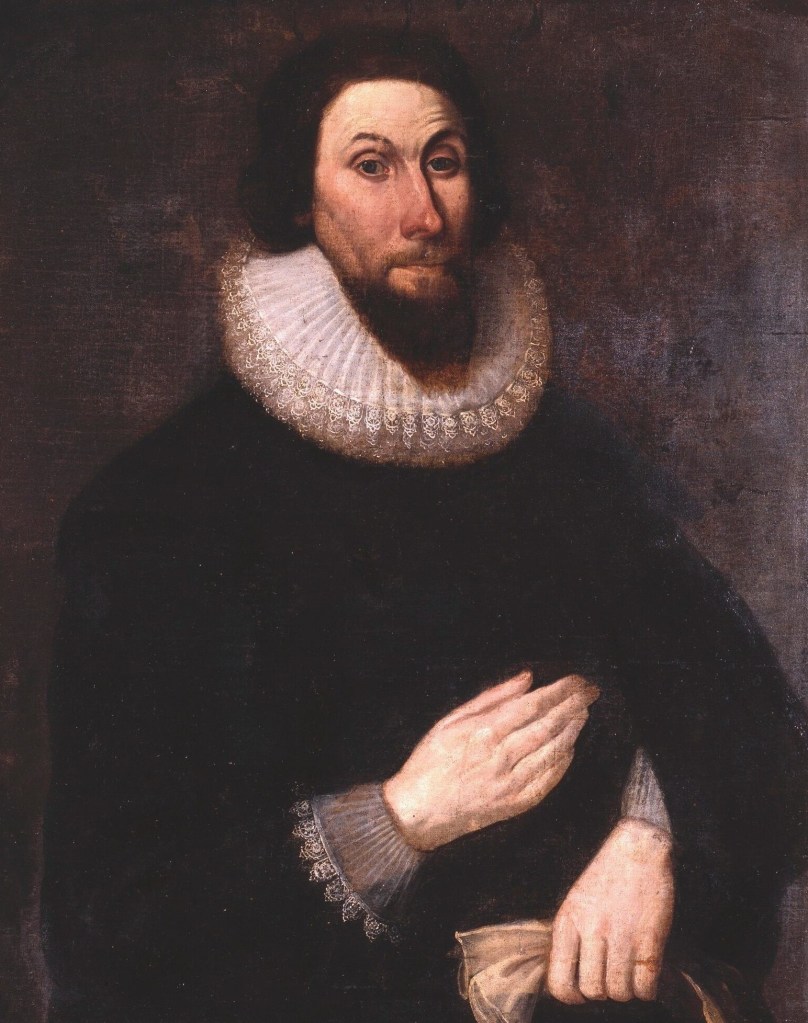
The Massachusetts Bay Colony was founded in 1630 by a group of Puritans from England. Its founding had its history in the religious disagreements of the English Reformation. English Puritans wanted to “purify” the Anglican Church from within, ridding the religious practices that resembled Catholicism. Separatists didn’t think this was possible, and instead, chose to create their own congregations. While facing persecution, the Separatists, or “Pilgrims” sought freedom in the New World, where they could practice their religion as they pleased. Ten years before the Massachusetts Bay Colony got underway, a previous colony called the Plymouth Colony was settled on the coast of Massachusetts in 1620 for the same reasons of religious freedom and new economic opportunities. En route to Plymouth, 41 settlers signed the Mayflower Compact, an agreement for the colonists to govern themselves, a beacon for early representative government. The early Pilgrims faced a difficult first winter and nearly half of the colonists died. (Davidson, p. 89) The survival of the Plymouth colonists laid the foundations for the later Massachusetts Bay Colony. As an early leader of the Massachusetts Bay Colony, John Winthrop, citing scripture, claimed that the new colony would be a “City upon a Hill.” (Bremer, p. 171) The strong religious convictions of the early Puritans impacted all aspects of colonial life in New England. Eventually, the Plymouth Colony was absorbed into the Massachusetts Bay Colony.
What were the initial conditions at first landing?
The colonists at the Massachusetts Bay Colony faced an unfavorable climate in New England. “A northern and hilly land of dense forests, sharp slopes, stony soils, and a short growing season, New England demanded hard labor to make a farm and offered little prospect of getting rich.” (Taylor, p. 159) Unlike the settlers of Virginia, who benefitted from long growing seasons and fertile soil, the Massachusetts Bay Colony had to deal with more challenging conditions, and they made the most of the resources available to them. While the Virginia colony was founded mostly by men searching for gold and wealth, the settlers of the Massachusetts Bay Colony consisted of entire families, looking to begin a new life in North America. In the first year of the colony’s settlement, seventeen ships arrived with about 1,000 English men, women and children, who were mostly Puritan. (McDougal, p. 50) The emigration of Puritans to Massachusetts starting in 1630 is referred to as the “Great Migration.” (Taylor, p. 165) The migration was greater in size and more thorough in planning than all previous expeditions to North America. The port town of Boston became the capital. (McDougal, p. 50) Throughout the 1630s and 1640s, the Puritans began to spread out from the coastal towns, and eventually founded new colonies such as Connecticut and Rhode Island. By 1660, 20,000 of the region’s 33,000 inhabitants resided in Massachusetts. (Taylor, p. 166)
How did the colony become sustainable?
Massachusetts was sustainable because of the Puritan work ethic as “the religious and the economic were interdependent in the lives of people who saw piety and property as mutually reinforcing.” (Taylor, p. 166) While New England demanded more labor and produced smaller profits, it also permitted longer and healthier lives in comparison to the Chesapeake colonies. This was caused by faster-flowing rivers and streams which reduced diseases such as malaria or dysentery. (Taylor, p. 170) By 1700, New England’s colonial population was the healthiest, most populous and the most democratic in terms of the distribution of property. Because of the shorter growing season and rocky soil, Massachusetts colonists could not grow the cash crops of the South. Instead, Massachusetts raised small crops such as wheat, rye, maize, beans, potatoes, pumpkins, squash, and other garden plants, but these crops were mostly for the family. (p. Taylor, p. 171) The Massachusetts colonists also raised livestock such as pigs, sheep, cattle, oxen, and horses. (p. Taylor, p. 171) They hunted wild turkey and dear and fished for shellfish, oysters, and lobsters. (Davidson, p. 99) The colonists hunted whales for products such as oil and ivory. (Davidson, p. 99) New England had extensive forests and the wood was used for shipbuilding. During the 1640s, Massachusetts and the rest of the New England region developed a complex and profitable network of commerce due to excess agricultural products, the fishing industry, and shipbuilding. (Taylor, p. 175) Massachusetts played a major role in these sectors of the English economy.
What Was a Typical Day for the Colonists?
The challenging environment of Massachusetts had an impact on the daily lives of the settlers. “It took a family to cope with the diverse and constant demands of building and maintaining a farm in New England.” (Taylor, p. 172) There were fixed roles for men and women. Men cleared trees, constructed the infrastructure necessary to run the farm, tended to the livestock, harvested the hay and cultivated the grain crops. (Taylor, p. 172) The women maintained the home and garden, cared for what was often a large family, made clothing and soap, and prepared and preserved food. (Taylor, p. 172) Similar to England, Massachusetts was a patriarchal society. Men were considered heads of the household and had more extensive rights in the colony. Women could not vote or hold public office. However, Puritanism viewed women as spiritual equals to men and after 1650, women outnumbered men as full church members. (Taylor, p. 174) “Women played a leading role in the oral circulation of news and opinion that determined the standing of men, as well as fellow women, in the community…” (Taylor, p. 174) Women could appear as plaintiffs, defendants, and witnesses in New England courts, and appear to have had more influence in their society in comparison to the Chesapeake colonies. (Taylor, p. 174) Family life was very important in the Puritan culture. The average family had 7 or 8 kids. (Davidson, p. 98) From a young age, children were expected to help with the family farm or trade. Children were also encouraged to read the Bible and follow the ways of the Puritan teachings.
Religion was at the center of life in the Massachusetts Bay Colony. There was no separation of church and state in the early colonial period of Massachusetts. Influential Puritan religious leaders held important government posts in the General Court, in which male church members elected representatives to an assembly. (Davidson, p. 95) While the Puritans left England to practice their religion freely, they did not plan to extend religious freedom to other groups such as Anglicans, Quakers, or Catholics. “More than the colonists in any other region, the orthodox New English maintained that they had a divine mission to create a model society in America: a Bible Commonwealth dedicated to the proper worship of God and to the rules of a godly society.” (Taylor, p. 178) The Puritans believed that they had been a chosen people by God, and all circumstances, whether good or bad, were direct consequences of their level of piousness and holiness. They viewed outsiders with suspicion and sought to keep non-Puritans out of government. (Davidson, p. 95) With a strong emphasis on reading the Bible, the Massachusetts colonists established the first press in English America at Cambridge in 1640. (Taylor, p. 179) Book ownership was higher in New England than anywhere else in the world. The high literacy rates of New England would impact the pre-Revolutionary period when tracts like Thomas Paine’s Common Sense circulated the populace.
The Puritans’ religious fanaticism and devotion to the spirtual world led directly to the events of the Salem Witch Trials, and the lack of religious freedom led to dissent within the colony. These topics will be discussed in Part 2… (Read Here)

Works Cited
Taylor, Alan/ Foner Eric (EDT). American Colonies The Settling of North
America. Penguin Group USA, 2002.
Mcdougal, Holt. Americans, Grades 9-12 New Jersey: Mcdougal Littell the
Americans. Holt Mcdougal, 2007.
Davidson, James West., et al. The American Nation. Prentice Hall, 2000.
Bremer, Francis, J., John Winthrop: America’s Forgotten Founding Father,
Oxford University Press, 2005
Lauterborn, David. “Blood and Betrayal: King Philip’s War.” HistoryNet,
HistoryNet, 12 July 2015, www.historynet.com/blood-and-betrayal-king-
philips-war.htm.
Related Posts:
 Benevento's History Blog
One response to “The Massachusetts Bay Colony (Part 1): Settlement and Life of the Puritans”
[…] Parts 1 (https://history6696.wordpress.com/2023/07/13/the-massachusetts-bay-colony-part-1-settlement-and-life…😉 and 2 […]
LikeLike