
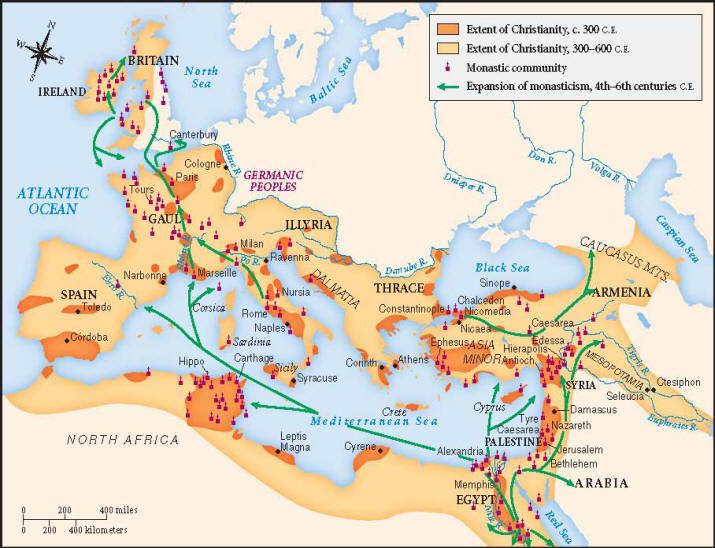
In my previous two posts, I focused on the influence of Ancient Rome on the United States in the areas of law and government, and culture. In this post I focus on the spread of Christianity within the Roman Empire and the influence of Christianity within the history of the United States. I also conclude my 3-part post on Ancient Rome’s influence on the United States.
For centuries, the Romans served many gods and goddesses, inspired by the Greek polytheistic religion. In the beginning of the Common Era, Christianity emerged from the teachings of Jesus of Nazareth, who lived during the height of the Roman Empire. Christianity first spread in the eastern part of the Roman Empire, and then to the west. Up until the 300’s AD, Christians in the empire were persecuted, beaten and killed. They were blamed for any problems emerging within the Empire. Despite this, the new religion continued to spread while Christians worshiped underground. By 313 AD, Emperor Constantine became a Christian and passed the Edict of Milan. He offered to citizens the promise of religious freedom. Constantine was baptized into the Christian faith shortly before his death. (Knox, ancient.eu) In 380 AD, Emperor Theodosius made Christianity the official religion of the Roman Empire and banned the old Pagan religions. After the fall of the empire, Christianity continued to spread throughout the world, and in the Middle Ages, had a stronghold on power and culture in the Western world. Kings allied with popes, and the Catholic Church became one of the only unifying powers in the challenging years of the Dark Ages. “Bishops and church leaders modelled their organization on the administration machinery of the old Empire.” (Tingay and Dadcock, p. 204) Christianity has had an enormous impact on the history and development of the United States. Many early American settlers such as the Pilgrims arrived from Europe for religious freedom. Christianity played a critical part in their daily lives. Many Christian denominations emerged, but with the core beliefs intact. Today, Christianity is the most practiced religion in the world and within the United States. “In Pew Research Center telephone surveys conducted in 2018 and 2019, 65% of American adults describe themselves as Christians when asked about their religion.” (pewforum.org) Christianity, a religion that began and first expanded in the Roman Empire, has shaped our society, culture, beliefs and institutions.
In almost every aspect of Americans’ lives, traces of the Roman Empire can be seen. Ancient Rome was a fascinating and inspiring civilization. Even with the fall of the Empire, and the emergence into the Dark Ages, Roman influence lived on. It was revived by the Renaissance scholars, brought across the Atlantic Ocean with explorers and pioneers, and continues to be a strong influence on American government and culture. Our basic principles, morals, ethics, interests, and livelihoods, have been shaped by varying degrees by the advancements, achievements and ideas of the Romans. From American infrastructure, laws, founding documents, entertainment, art, religion, and education, it is quite clear; Ancient Rome is all around us.
Works Cited
Tingay, Graham, and John Badcock. These Were the Romans. Dufour Editions, 2008.
Spielvogel, Jackson J. Discovering Our Past: a History of the World. McGraw-Hill Education, 2014.
Knox, John S. “Christianity.” Ancient History Encyclopedia, Ancient History Encyclopedia, 22 Sept. 2016, http://www.ancient.eu/christianity/.
“In U.S., Decline of Christianity Continues at Rapid Pace.” Pew Research Center’s Religion & Public Life Project, 9 June 2020, http://www.pewforum.org/2019/10/17/in-u-s-decline-of-christianity-continues-at-rapid-pace/.
Related Posts:
 Benevento's History Blog