
In my previous post, I focused on Ancient Rome’s influence on the United States in the area of law and government. In this post (Part 2), I focus on the legacy of Ancient Rome’s culture.
Rome’s legacy can be seen in many aspects of our American culture. Many western countries, including the United States use the Latin alphabet, which has expanded from 22 to 26 letters. Italian, French, Spanish, Portuguese and Romanian- the Romance Languages- are derived from Latin, the language of the Romans. English contains thousands of Latin-based words. (Spielvogel, p. 357) Roman writers like Cicero, Virgil, Ovid, Livy, Seneca and Tacitus wrote effectively in the Greek literary categories of history, lyric poetry, oratory, epic, tragedy, comedy, and biography. (Tingay and Dadcock, p. 204- 205) “Without this classical literature, in both Greek and Latin, preserved by the Church in the West, and by scholars and libraries in the East, the history and civilization of later Europe would have been very different.” (Tingay and Dadcock, p. 205) Great Roman writers are still studied and admired today, and have influenced modern genres in literature, cinema and television.
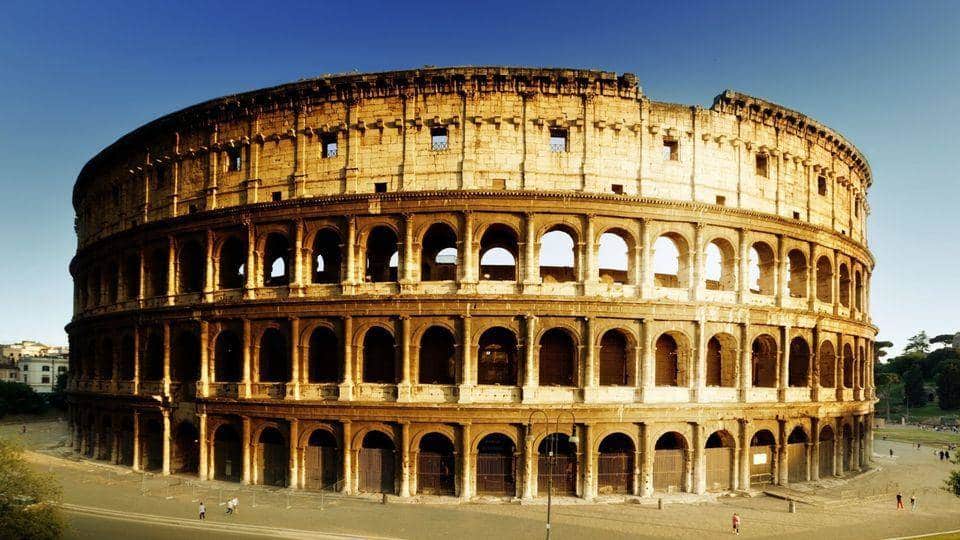
Modern day American architecture and construction has been highly influenced by the Ancient Romans. Many public and private buildings use domes and arches inspired by Roman architecture. A visitor to Washington DC can see the dome of the Capitol building and the columns of the Supreme Court building, inspired by both Roman and Greek ideas. Concrete, a Roman development, continues to be a major building material today. (Spielvogel, p. 357) The Romans built large public buildings, such as the Colosseum and the Pantheon, which still inspire and amaze tourists. They built private palaces, bridges and aqueducts which displayed their genius and dominance. Many modern cities, such as New York City, retain the traditional grid pattern in their streets much like a Roman city. The infrastructure of a Roman city was quite remarkable for the times. The Romans built extensive roads and plumbing systems. Their ability to use heating systems in wealthy homes and baths shows the ingenuity of the Romans which has inspired later civilizations. The Romans were expert surveyors, road builders, and water engineers. (Tingay and Dadcock, p. 209) The Colosseum, which sat between 50,000 and 80,000 spectators, is an ancient marvel. A retractable roof protected the gladiators and spectators from the elements. The Colosseum floor was likely flooded with water for mock naval battles. There were also trap doors and elevators which brought beasts and gladiators to the floor of the stadium, from cells below. Many of these feats of engineering would not be rivaled until recent history. Americans have been inspired by these architectural feats and have built modern marvels such as stadiums, arenas, suspension bridges and skyscrapers.
The Romans borrowed many aspects of art from the Greeks. But Roman artists achieved real distinction and originality in their portrait statues and carvings. Roman statues looked more realistic and detailed compared to Greek statues. Triumphal arches and memorial columns were often imitated by later leaders. (Tingay and Dadcock, p. 212) Neoclassical paintings and architecture of the modern era drew their inspiration from Greek and Roman ideas. There are many examples of American art and architecture that take on the neoclassical style such as Thomas Jefferson’s Monticello.
Roman leisure and entertainment has impacted American culture. The Colosseum was the model for later arenas that would serve the public as places for sport and entertainment. While today, Americans don’t watch gladiators fight each other or animals to the death, Americans do get together to watch competition in sports such as baseball, basketball, or football. The Circus Maximus sat about 100,000 spectators who watched chariot races, and cheered for their favorite racer, much like a current sports fan cheers for a favorite team or athlete. While Americans go to plays or movies for entertainment, Romans attended dramas that were inspired by Greek tragedies and comedies. Both Ancient Romans and modern Americans enjoy being entertained in large public settings.
The Ancient Romans have impacted our education and understanding of the world. They made breakthroughs in Science, Medicine, History, and Literature that still impact our lives. During Roman times, Greek scientists made lasting discoveries. Archimedes discovered the fundamental laws of hydrostatics, mechanics and ratios. Aristarchus concluded that the earth was a sphere, spinning in space as it orbited the sun. Euclid’s textbooks on geometry are still widely used by students. Despite some inaccuracies, Ptolemy’s writings and maps summarized Roman knowledge of the earth’s surface, and remained in use until the Age of Discovery, fourteen centuries later. (Tingay and Dadcock, p. 209) Julius Caesar used the skills and knowledge of Alexandrian astronomers to devise a calendar which remains the basis of the one we use today. (Tingay and Dadcock, p. 209) July and August are named after Julius Caesar and Augustus. Galen, the court physician of Marcus Aurelius, wrote extensively on anatomy, physiology, pathology, and a wide range of medical subjects. His ideas would not be challenged until the sixteenth century. (Tingay and Dadcock, p. 211) Romans built hospitals and recognized the importance of sanitation. Their standard of hygiene went unmatched until the nineteenth century. (Tingay and Dadcock, p. 211) The field of history, while invented by the Greeks, was carried further by Roman historians like Livy and Tacitus. Much of what we know about Roman history, from its founding, to its fall, is because of the extensive writings of historians. Ancient Romans have had an enormous impact on the education that is highly valued in the United States.
Works Cited
Tingay, Graham, and John Badcock. These Were the Romans. Dufour Editions, 2008.
Spielvogel, Jackson J. Discovering Our Past: a History of the World. McGraw-Hill Education, 2014.
Knox, John S. “Christianity.” Ancient History Encyclopedia, Ancient History Encyclopedia, 22 Sept. 2016, http://www.ancient.eu/christianity/.
“In U.S., Decline of Christianity Continues at Rapid Pace.” Pew Research Center’s Religion & Public Life Project, 9 June 2020, http://www.pewforum.org/2019/10/17/in-u-s-decline-of-christianity-continues-at-rapid-pace/.
Related Posts:
 Benevento's History Blog