
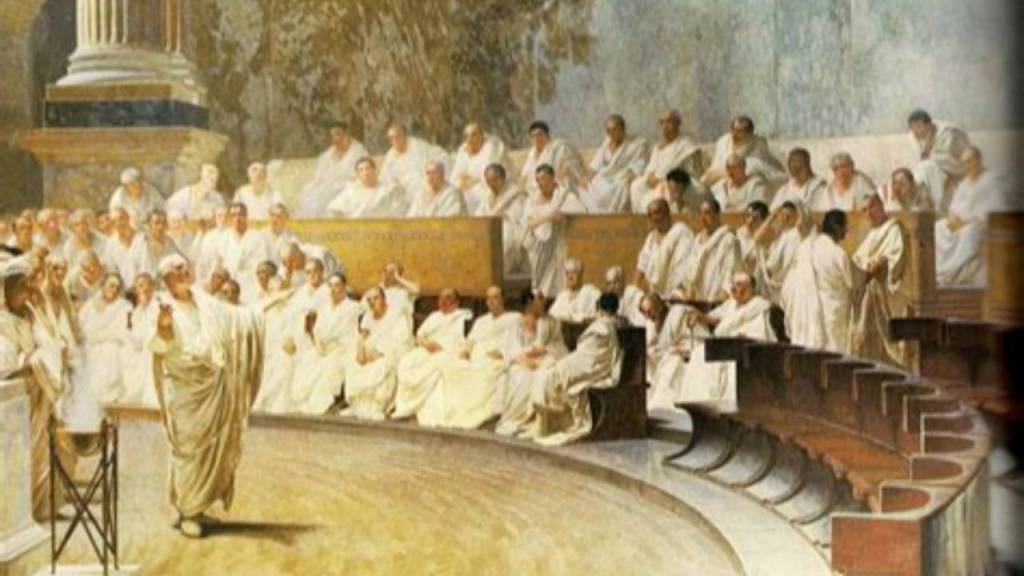
My next three blog posts will focus on Ancient Rome’s influence specifically on the present-day United States. Part 1 will focus on Law and Government. Part 2 will focus on Culture, and Part 3 will focus on the spread of Christianity. Ancient Rome’s influence is all around us.
Ancient Rome has had a tremendous impact on Western Civilization and world history, right to the present day. American political institutions and American culture owe much to Rome. While Rome’s legacy can be felt all around the world, the impact that Rome has had on the United States can be found in many aspects of life. The Romans were a practical people, whose innovations changed the world and allowed their empire to expand from Europe to the Middle East, and into North Africa. At the peak of its power during the Pax Romana, the Roman Empire was generally peaceful and grew economically and culturally. Trade routes developed, the empire gained more territory, and the cities in the empire were beautified with temples, government buildings, gardens, fountains and baths. After the fall of the Western Roman Empire in 476 AD, the Roman legacy lived on. The new German kingdoms adopted many aspects of Roman culture. However, throughout the Middle Ages, some aspects of Roman brilliance were lost. Influential Roman writers were forgotten, and great structures fell into decay. Christianity, which began and expanded in the empire, continued to spread and gain power throughout the Middle Ages. During the Renaissance, Roman and Greek manuscripts were rediscovered by Humanist scholars. There was a new excitement to learn from ancient cultures, and Ancient Rome was again revered. With the Renaissance, the legacy of Rome continued to spread, including to a new American nation, which would eventually create a Republic, highly influenced by the Roman Republic. To this day, the United States has been widely impacted by Ancient Rome in government and law, culture, and the spread of Christianity.
Many beliefs about law and justice in the American legal system come directly from Roman ideas. These beliefs that we hold dear include the idea that everyone is equal under the law, a person is innocent until proven guilty, and judges must decide cases fairly. (Spielvogel, p. 356) We take these concepts for granted but in ancient times, these were revolutionary ideas. In other ancient cultures, people were treated differently under the law and faced arbitrary punishments, depending on social status. While Rome was inspired by Greek democracy, the Romans developed their Republic with new ideas and innovations. Legislative assemblies, representing the people, discussed and passed laws. Citizens in the republic elected their leaders. The most influential legislative body was the Roman Senate, and the United States Senate is considered the more prestigious house of Congress. Romans expected the citizens to do their civic duty and vote, participate in government, and help to improve their communities, all of which are a part of our American values and beliefs. (Spielvogel, p. 356)
Roman law had been codified in the sixth century by Eastern Roman Emperor Justinian. This code of laws inspired later leaders, including Charlemagne, Napoleon, and America’s founding fathers. Roman ideas that no man shall be a judge in his own case, and a man should have the right to face his accusers, are the same ideas sketched into our Bill of Rights, written by James Madison in the 18th century. Many of the most basic ideas and freedoms that are cherished by American citizens, were directly inspired by Roman ideas. The American government’s symbol of the bald eagle was also passed down, as Roman emperors displayed the imperial eagle as a symbol of their power and authority. (Tingay and Dadcock, p. 206) The American government’s structure and bureaucracy was inspired and influenced by the Romans. While the Roman government had many magistrates with varying responsibilities, the American government has different cabinet secretaries running the executive departments. While Rome had proconsuls who served as governors over the provinces, the United States has fifty states run by governors. (Spielvogel, p. 329) From the local to the federal level, the structure of our government closely resembles the Roman government.
Works Cited
Tingay, Graham, and John Badcock. These Were the Romans. Dufour Editions, 2008.
Spielvogel, Jackson J. Discovering Our Past: a History of the World. McGraw-Hill Education, 2014.
Knox, John S. “Christianity.” Ancient History Encyclopedia, Ancient History Encyclopedia, 22 Sept. 2016, http://www.ancient.eu/christianity/.
“In U.S., Decline of Christianity Continues at Rapid Pace.” Pew Research Center’s Religion & Public Life Project, 9 June 2020, http://www.pewforum.org/2019/10/17/in-u-s-decline-of-christianity-continues-at-rapid-pace/.
Related Posts:
 Benevento's History Blog